
How to Store Craft Gin: Keep Every Bottle Fresh
Table of Contents
- What You'll Need to Store Craft Gin Properly
- Ideal Conditions: Temperature, Light, and Humidity
- Gin Shelf Life After Opening: What Changes and When
- The Best Temperature to Store Gin (And What to Avoid)
- Storing Unopened vs Opened Bottles: What's Different
- How to Display Gin Bottles Without Damaging Them
- Common Mistakes to Avoid When Storing Craft Gin
- Conclusion
- Frequently Asked Questions
Last Updated: September 29, 2026
What You'll Need to Store Craft Gin Properly
To store craft gin well, you need only a few simple tools. You do not need a cellar or a special cabinet. You need to control light, heat, and air.
Here is what to gather before you start:
- A cupboard or shelf away from windows and radiators
- Airtight stoppers or corks for opened bottles
- A dark bottle or opaque bag for long-term storage
- A thermometer if your storage spot runs warm
- A pen and labels to date each bottle when you open it
That is the whole kit. Most of it you already own.
The single biggest mistake is treating gin like wine. Gin is a spirit, not a living product. It will not improve with age in the bottle, so your goal is preservation, not development. Keep it stable and it will taste the same in a year as it did on day one.
Ideal Conditions: Temperature, Light, and Humidity
The ideal storage conditions for craft gin are a steady, cool temperature, complete darkness, and moderate humidity. Fluctuation causes more harm than any single extreme.
Here is what to aim for:
- Temperature: Cool and constant, ideally between 15°C and 20°C
- Light: Total darkness, or as close as you can get
- Humidity: Moderate, around 50-60%, to protect labels and corks
- Position: Upright, so liquid never touches the cap
Temperature swings are the quiet killer. A bottle that moves from a cold cupboard to a warm windowsill and back again expands and contracts. That movement pushes air in and out past the seal. Each cycle lets a little more oxygen in.
Light matters just as much. UV rays break down the botanical compounds that give gin its character. Clear glass offers almost no protection. This is one reason many distillers, including guidance from the Scotch Whisky Association on spirit storage, favour darker glass for long-kept spirits. If your bottle is clear, keep it in a cupboard.
Gin Shelf Life After Opening: What Changes and When
Gin shelf life after opening is measured in months and years, not days. An unopened bottle keeps almost indefinitely. An opened bottle is best within one to two years.
What changes is not the alcohol. At around 40% ABV, the spirit is stable and self-preserving. What changes is the flavour.
Once you break the seal, oxygen starts working on the botanicals. Juniper, citrus, coriander, and floral notes fade at different rates. The brighter, sharper notes usually go first. What is left can taste flatter and less defined.
Signs your gin is past its best:
- The aroma smells dull or muted
- Citrus and floral notes have disappeared
- The taste feels thin or slightly bitter
- The liquid has changed colour
A change in colour is the clearest warning. Clear gin that turns cloudy or yellow has taken on something it should not have. Check the seal and the storage spot.
The Best Temperature to Store Gin (And What to Avoid)
The best temperature to store gin is a steady 15°C to 20°C. Room temperature in a shaded cupboard is perfect. You do not need to refrigerate it.
Cold does not damage gin, but it is not necessary. The fridge is fine for a bottle you are drinking this month. For long-term storage, a cool cupboard beats the fridge because it avoids the temperature swings of a door opening and closing.
What to avoid:
- Direct sun on a windowsill
- The top of a fridge or freezer, which runs warm
- A shelf above a radiator
- A car boot or shed that bakes in summer and freezes in winter
- Any spot where the temperature jumps around daily
Freezing will not ruin gin, but it is pointless. It only makes the bottle sweat when it comes back to room temperature, and that condensation can damage the label.
For serving, a short spell in the freezer is a different matter. Many drinkers chill their gin before pouring. Just do not leave it there for months.
Storing Unopened vs Opened Bottles: What's Different
Unopened and opened bottles need different treatment. An unopened bottle is sealed and protected. An opened bottle is exposed to air every time you pour.
Unopened bottles:
- Keep them upright in a cool, dark place
- They hold their quality for years
- No special handling needed beyond light and heat control
Opened bottles:
- Reseal tightly after every pour
- Use the original cap, or an airtight stopper if it is lost
- Keep them dark and cool
- Aim to finish within one to two years for best flavour
The key difference is air. A sealed bottle has almost none inside. An opened bottle takes on a fresh hit of oxygen each time you open it. The more air space in the bottle, the faster the botanicals fade.
If you are down to the last few measures, consider decanting into a smaller bottle. Less air space means slower flavour loss.
How to Display Gin Bottles Without Damaging Them
You can display gin bottles and still protect them. The trick is to keep them out of direct light while showing off the design.
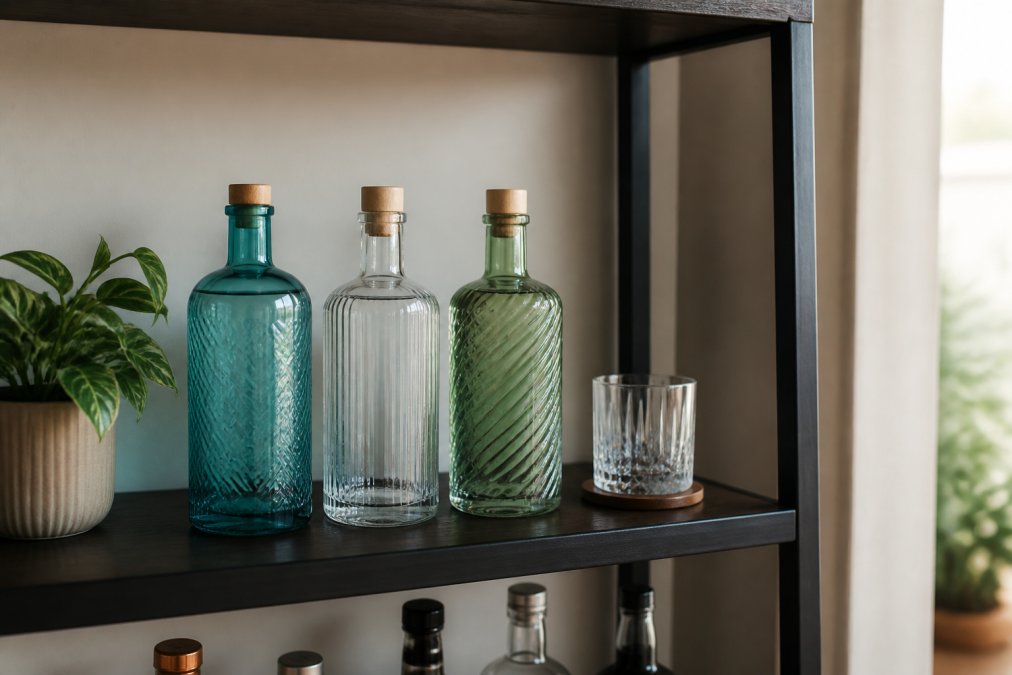
A few rules keep a display safe:
- Choose a shelf away from windows and lamps
- Rotate bottles so none sits in a bright spot for months
- Keep bottles upright, never on their side
- Use a cabinet with doors if the room gets a lot of sun
- Keep the display cool, not above a heat source
Some bottles are worth more than their contents. At Glaswegin, our minimalistic bottle design is built to be up-cycled once empty. Customers have turned theirs into items like table lamps. That is a good reason to keep the bottle in good condition while it still holds gin.
Display is a balance. You want the bottle seen, but not sunbaked. A shaded shelf near the bar gives you both.
Common Mistakes to Avoid When Storing Craft Gin
Most storage problems come from a handful of habits. Fix these and your gin will last.
- Leaving bottles in sunlight. UV light strips flavour fast. Move them to a cupboard.
- Storing near heat. Cookers, radiators, and boilers all shorten shelf life.
- Laying bottles flat. Liquid sits against the cap and can degrade the seal. Keep them upright.
- Losing the cap. A loose stopper lets air in. Replace it with an airtight one.
- Keeping a near-empty bottle for months. More air space means faster flavour loss.
- Ignoring the seal. A damaged cap lets oxygen in even in a dark cupboard.
The fix for most of these is one good storage spot. Pick a cool, dark cupboard and keep every bottle there. It takes five minutes to set up and saves the gin you paid for.
Conclusion
Good storage is not complicated, but it is easy to get wrong. Light, heat, and air are the three things that quietly change your gin. Control them and every pour tastes the way the distiller intended.
At Glaswegin, we make that easy. Our gins are distilled and bottled in Glasgow with a smooth, straightforward flavour. Our refillable pouches cut down on packaging and cost, and our bottles are designed to be up-cycled rather than binned. You get a gin worth storing and a bottle worth keeping.
Get started with Glaswegin and enjoy a genuine taste of Glasgow, fresh to the last drop.
Frequently Asked Questions
Does craft gin go bad after opening?
Craft gin doesn't spoil in the way food does, but its flavour fades over time once opened. Oxidation gradually softens the botanicals, and the alcohol content can drop slightly if the bottle is left half-empty for months. For the best drinking experience, aim to finish an opened bottle within six to twelve months. Storing it upright in a cool, dark cupboard slows this process considerably.
Should gin be stored in the fridge or freezer?
A standard fridge or freezer isn't necessary for storage. Gin stays in good condition at room temperature, ideally between 15°C and 20°C. Freezing won't damage the spirit because of its high alcohol content, but it can dull the botanical aromas when you pour. If you prefer gin served very cold, chill the glass or add ice rather than storing the whole bottle in the freezer long-term.
How long does an opened bottle of gin last?
An opened bottle of craft gin keeps its best flavour for roughly six to twelve months when stored upright in a cool, dark place with the cap tightly sealed. After that, it remains safe to drink but the botanical profile flattens. If you notice a dulled aroma or a slightly flat taste, the gin is past its peak rather than spoiled. Buying refill pouches helps you top up without leaving a half-empty bottle sitting around.
Should gin bottles be stored upright or on their sides?
Store gin bottles upright. High-alcohol spirits can slowly degrade natural cork stoppers if left lying down, and the liquid may pick up a corky taste over time. Upright storage also reduces the risk of leaks and keeps the seal in good condition. This matters more for craft gins sealed with cork rather than screw caps, so check the closure before deciding where to place the bottle.