
Is Refillable Gin Actually Cheaper?
Table of Contents
- The Real Cost of Refillable Gin
- Gin Refill Cost Breakdown
- Gin Refill vs New Bottle: The Numbers
- How to Refill a Gin Bottle at Home
- Are Gin Refills Worth It Beyond Price?
- Environmental Impact and Sustainability
- Making the Switch to Refillable Gin
- Frequently Asked Questions
Last Updated: October 5, 2026
The Real Cost of Refillable Gin
When you're paying premium prices for gin, every pound matters. The question isn't whether refillable gin exists, it's whether refillable gin is actually cheaper. At Glaswegin, we've watched customers weigh up the economics of refill pouches versus buying new bottles, and the answer is more nuanced than most people expect.
The appeal is straightforward: buy a bottle once, then refill it repeatedly at a lower cost. But refillable gin isn't universally cheaper. It depends on what you're comparing, how often you drink, and whether you factor in the environmental benefits beyond pure price.
Here's what actually happens when you do the maths.
Gin Refill Cost Breakdown
A refillable gin option works like this: you purchase a full bottle initially, then order refill pouches that cost less than buying another complete bottle. The savings come from avoiding the cost of the glass bottle and packaging each time.
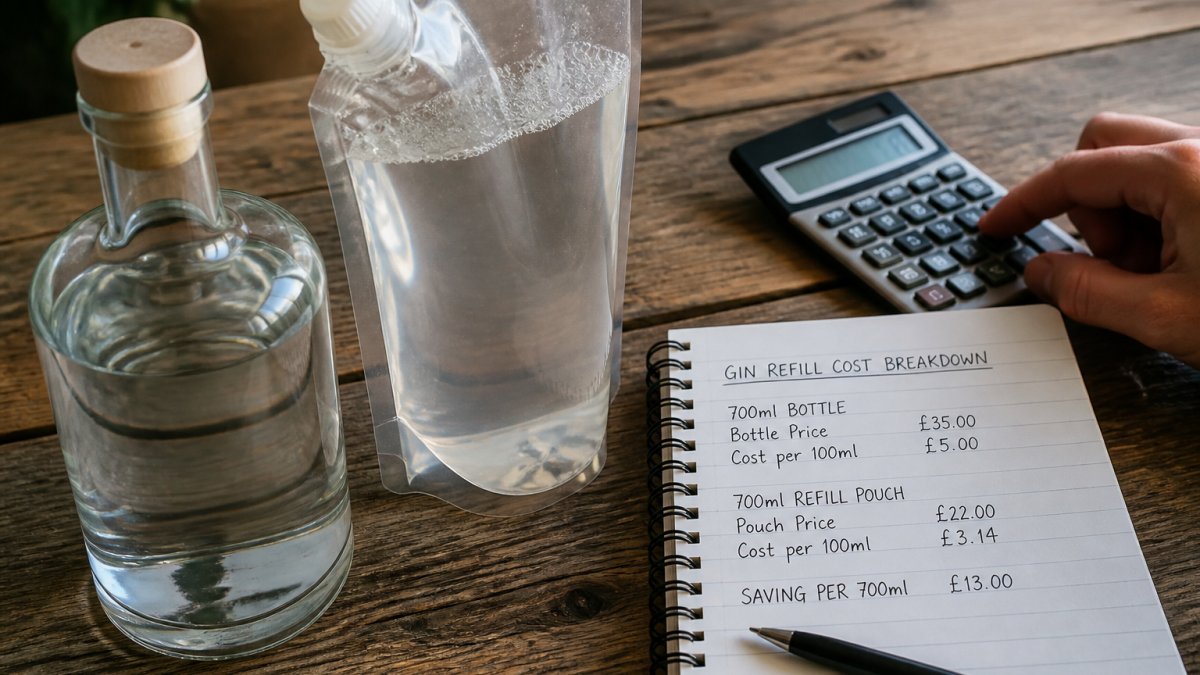
With Glaswegin, the economics look like this:
| Product | Cost | Per 70cl Bottle |
|---|---|---|
| Glaswegin Original Gin 70cl (full bottle) | £39.00 | £39.00 |
| Glaswegin Raspberry & Rhubarb Gin 70cl (full bottle) | £37.50 | £37.50 |
| Glaswegin Raspberry and Rhubarb Gin Refill Pouch 70cl | £32.00 | £32.00 |
The refill pouch saves you £5.50 compared to buying a new bottle of the same flavour. That's roughly a 15% saving per refill. If you go through one bottle per month, you're looking at annual savings of around £66 just from switching to refills after your first purchase.

But here's where it gets interesting: that saving only applies if you keep using the same bottle. The initial bottle purchase is a sunk cost. You're paying full price upfront, then recouping the difference over time through refills.
Gin Refill vs New Bottle: The Numbers
The true comparison isn't refill versus new bottle in isolation. It's whether the cumulative cost of refilling one bottle beats buying multiple new bottles over the same period.
If you drink one 70cl bottle per month:
- Buying new bottles every month: 12 bottles × £37.50 = £450 per year
- Buying one bottle plus 11 refills: £37.50 + (11 × £32.00) = £389.50 per year
That's a saving of £60.50 annually. Not insignificant, but not dramatic either.
The maths shifts if you're a heavier drinker. At two bottles per month:
- Buying new: 24 × £37.50 = £900 per year
- One bottle plus 23 refills: £37.50 + (23 × £32.00) = £773.50 per year
Now you're saving £126.50 per year. The more you drink, the more the refill model pays for itself.
However, there's a catch. You need to keep the same bottle intact. If you break it, lose it, or decide you want a different style, you're back to buying full bottles. For some households, that's a real risk. For others, the bottle becomes a design feature, something you genuinely want to keep using.
How to Refill a Gin Bottle at Home
Refilling is straightforward, which removes a common barrier. You don't need to post anything back or arrange collection. The pouch arrives at your door, you pour it into your existing bottle, and you're done.
The Glaswegin refill pouches are designed for simplicity. They come with a pouring spout that fits standard gin bottles. You simply squeeze the contents into your bottle until it's full, then recycle the pouch. The pouches themselves are now recyclable at collection points throughout the UK, including weekly soft plastic collections at major supermarkets like Tesco, Sainsbury's, and Morrisons.
The process takes about two minutes. No special equipment, no logistics headaches, no waiting for collection. That simplicity is worth something on its own, it removes friction from the decision to refill rather than rebuy.
Glaswegin Raspberry and Rhubarb Gin Refill Pouch 70cl →
Are Gin Refills Worth It Beyond Price?
The financial case for whether refillable gin is actually cheaper is modest but real. Where the argument becomes stronger is when you factor in what you're not paying for: packaging waste, transport emissions, and the environmental cost of manufacturing new glass bottles repeatedly.
Glaswegin's refill pouches are made from flexible plastic that weighs significantly less than glass. Manufacturing and transporting a pouch uses less energy and generates fewer emissions than producing and shipping a full glass bottle. If sustainability matters to you, and for many gin enthusiasts, it does, the refill model delivers a tangible environmental benefit beyond the price saving.
There's also the aesthetic argument. The Glaswegin bottle is designed to be kept. Its minimalistic design works as a home bar centrepiece, and customers have reported using empty bottles as table lamps or decorative objects. If you genuinely want to keep the bottle, refilling makes sense. If you'd rather have variety and try different gins, buying new bottles might suit you better.
Environmental Impact and Sustainability
Glass is recycled widely, but recycling isn't free. The manufacturing process for glass is carbon-intensive. Every new bottle requires raw materials, high-temperature melting, and transport. Refill pouches sidestep much of that.
According to Glaswegin's own assessment, the manufacture and transport of glass is more carbon-intensive than the production of refill pouches. By using a pouch instead of a new bottle, you're reducing your carbon footprint per refill. Over a year of regular drinking, that adds up.
The pouches themselves are now designed to be recyclable. Glaswegin's latest iteration can be recycled at collection points across the UK, and most major supermarkets now offer weekly collections for flexible soft plastics. This means the entire cycle, buy, refill, recycle, is genuinely sustainable, not just marketing.
For environmentally conscious drinkers, the refill model isn't just about saving money. It's about reducing the material footprint of your gin consumption without compromising on quality or taste.
Making the Switch to Refillable Gin
If the refill model appeals to you, the transition is simple. You start with a full bottle, either Glaswegin Original Gin or one of the flavoured varieties like Raspberry and Rhubarb, then order refill pouches as needed.

The initial purchase is the same price as any premium gin. You're not paying a premium for the refill option. Then, each subsequent refill costs less. After your first refill, you've started recouping the decision. After your third or fourth, the cumulative saving becomes noticeable.
The main consideration is commitment. Refillable gin works best if you've found a gin you genuinely like and plan to keep buying it. If you enjoy variety, switching between different brands and styles, the refill model offers less advantage. But if you've found your gin, if you know what you like and want to keep drinking it, refillable options make both financial and environmental sense.
Glaswegin's refill pouches are available online with speedy delivery, so there's no logistical friction. You order when you run low, the pouch arrives, you refill, and you're done. It's as convenient as buying a new bottle, with the added benefit of lower cost and lower environmental impact.
Frequently Asked Questions
Is refillable gin actually cheaper than buying a new bottle?
Yes, refillable gin offers genuine savings. A refill pouch costs £32.00 compared to £39.00 for a full bottle of Glaswegin Original Gin. Over a year, if you refill your bottle 3-4 times, you save approximately £21-28 on that bottle alone. The savings increase if you refill more frequently or keep multiple bottles in rotation.
How much can you save with gin refills over time?
The savings depend on your consumption. Savings compound further when you factor in reduced packaging waste.
Are gin refill pouches recyclable?
Glaswegin's refill pouches are fully recyclable through flexible soft plastic collection schemes. Most major supermarkets, including Tesco, Sainsbury's, Morrisons and Co-op, now offer weekly collections for soft plastics. The pouches are also more environmentally sensitive than glass bottles because manufacturing and transporting glass requires significantly more carbon emissions than producing pouches.
Can you refill any gin bottle with any refill pouch?
Refills work best with bottles designed for the purpose. Glaswegin refill pouches (available in both Original and Raspberry & Rhubarb varieties at £32.00 each) are engineered to work seamlessly with Glaswegin bottles. The pouch design allows you to pour directly into your existing bottle without waste, making the refill process straightforward and maintaining the quality of the gin inside.
The honest answer to whether refillable gin is actually cheaper is yes, but with caveats. You'll save money if you drink regularly, stick with the same gin, and keep your bottle intact. The saving is modest, around 15% per refill, but it compounds over time. More importantly, if sustainability matters to you, the environmental case is stronger than the financial one. Get started with Glaswegin refill pouches and reduce both your spending and your carbon footprint with every refill.